HYDRATION

Hydration is the ingestion of water, in the amounts needed, to replenish the water in the body. Water in the body affects almost everything, from skin health and body weight to neurological and gastrointestinal functioning.

Proper hydration can also help prevent the development of chronic disease.

HOW I USE HYDRATION

As a woman with Multiple Sclerosis (MS),I use Hydration to help manage my MS. When I discovered that inflammation causes MS relapses, with relapses being the worsening of current or creation of new MS symptoms, I incorporated Hydration into my beneficial diet to do the following:

  • Maintain my health and help prevent the development of chronic disease, which is a major source of inflammation.

And managing inflammation helps manage my MS.

I ingest roughly a gallon of water per day to maintain my health.

I also suffer from bladder dysfunction which makes me susceptible to urinary tract infections (utis), another source of inflammation. Keeping hydrated helps minimize the occurrence of utis.

When I turned 50 yrs old, and entered menopause, I developed dry eyes. And I discovered that keeping hydrated helps manage my dry eyes, as well.

CAUTION

Ingesting large amounts of anything can be harmful, even water, so I always consume in moderation.

-Jen, aka. Power Chair Dorothy


REFERENCES

Allen, M. D., Springer, D. A., Burg, M. B., Boehm, M., & Dmitrieva, N. I. (2019). Suboptimal hydration remodels metabolism, promotes degenerative diseases, and shortens lifeJCI insight4(17), e130949.

Farrell, D. J., & Bower, L. (2003). Fatal water intoxicationJournal of clinical pathology56(10), 803–804.

Liska, D., Mah, E., Brisbois, T., Barrios, P. L., Baker, L. B., & Spriet, L. L. (2019). Narrative Review of Hydration and Selected Health Outcomes in the General PopulationNutrients11(1), 70.

Perrier, E. T., Armstrong, L. E., Bottin, J. H., Clark, W. F., Dolci, A., Guelinckx, I., Iroz, A., Kavouras, S. A., Lang, F., Lieberman, H. R., Melander, O., Morin, C., Seksek, I., Stookey, J. D., Tack, I., Vanhaecke, T., Vecchio, M., & Péronnet, F. (2021). Hydration for health hypothesis: a narrative review of supporting evidenceEuropean journal of nutrition60(3), 1167–1180.

Popkin, B. M., D’Anci, K. E., & Rosenberg, I. H. (2010). Water, hydration, and healthNutrition reviews68(8), 439–458.

Science Direct: Hydration


Not in Kansas Anymore (www.notinksanymore.com) is a site/blog authored and managed by Jen, aka. Power Chair Dorothy (pwrchr-dorothy). This site/blog is intended to provide educational and research information, and to share the author’s journey.

The author of this site/blog is not a medical physician and this site/blog does not provide medical advice. This site/blog contains information that should not be used in place of a visit, call, consultation or the advice of your physician or other qualified healthcare provider. If you choose to apply or implement any information posted at this site/blog, you do so at your own risk.

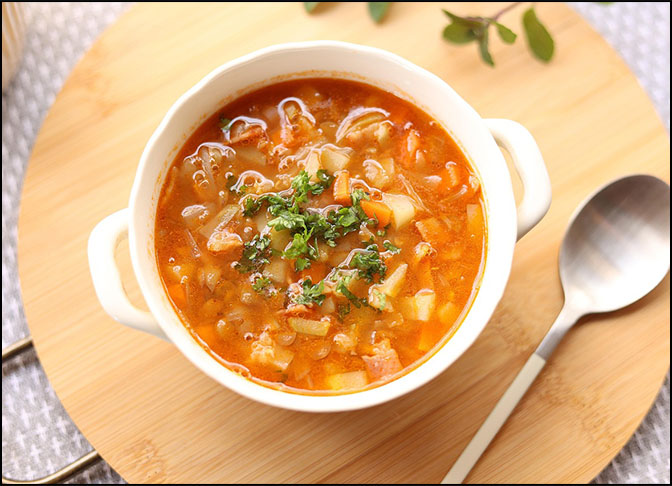
THE SOUP SOLUTION

I love a warm, comforting bowl of soup. Unfortunately, most canned and boxed soups contain ingredients that don’t exactly agree with me (ie. food sensitivities). The same with soups from most restaurants. Of course, the cost of buying healthier soups that contain less problematic ingredients can be prohibitive. And let’s not forget the cost of eating out and take out. The obvious solution, of course, is to simply make my own soup. Being a woman who knows how to cook, making my own soup should be easy, but as a woman with disabilities, my ability to physically cook is limited. Therefore, to create my own soup at home, I had to problem solve.

After much trial and error, I finally found success working at a smaller scale and relying on helpful cooking shortcuts, like my restorative broth mixes. I discovered that 4-cup, handled bowls work best for me. They are easier to manage, physically, than a large soup pot and can be easily put in the microwave. To eliminate the need for the cleaning and cutting of fresh ingredients, I experimented with dried, powdered, frozen, and even canned/jarred ingredients. By the end, I managed to develop several tasty recipes for single serving soups.

I also love Thai Curries and managed to create single serving versions of them as well. Even though Thai curries are technically not soups, I tend to treat them like soups and therefore have grouped those recipes in with my single serving soups.

SINGLE SERVING SOUPS

These soups also contain anti-inflammatory foods. Those anti-inflammatory foods being Carrots, Tomatoes, Artichoke Hearts, Pumpkin, Peanuts, and the ingredients in the Broth Mixes.

As a woman with Multiple Sclerosis (MS),I use these soups to help manage my MS. When I discovered that inflammation causes MS relapses, with relapses being the worsening of current or creation of new MS symptoms, I incorporated these soups into my beneficial diet to help manage inflammation. And managing inflammation helps manage my MS.

I share these recipes, in the hopes of helping others. Enjoy.

-Jen, aka. Power Chair Dorothy


Not in Kansas Anymore (www.notinksanymore.com) is a site/blog authored and managed by Jen, aka. Power Chair Dorothy (pwrchr-dorothy). This site/blog is intended to provide educational and research information, and to share the author’s journey.

The author of this site/blog is not a medical physician and this site/blog does not provide medical advice. This site/blog contains information that should not be used in place of a visit, call, consultation or the advice of your physician or other qualified healthcare provider. If you choose to apply or implement any information posted at this site/blog, you do so at your own risk.

BENEFICIAL DIET

As a woman with Multiple Sclerosis (MS), I’ve tried many things to manage my MS. Making changes to my diet, however, has produced the most profound and positive results.

And Yes, I said DIET. Many of us have a negative reaction to the word DIET. We envision something bland and boring that causes nothing but stress. Well, my diet contains seriously tasty food. There’s no stress when it comes to my diet. I love it.

And when I refer to “food”, I use the same definition as the FDA meaning that “food” includes food, the ingredients used to make food, beverages, and dietary supplements.

I first realized that diet could have an impact on my MS, when my symptoms calmed down after eating some Buffalo Wings. I did some research and discovered that the Chile Peppers in the wing sauce are extremely anti-inflammatory. Since discovering that inflammation causes MS relapses, with relapses being the worsening of current or creation of new MS symptoms, it made sense that these foods, that counter inflammation, would help stop MS relapses.

Of course, finding a diet that counters inflammation, and actually works for me, was not something that just came together overnight. It took years of trial and error, as I tried different foods and weighed costs versus benefits….etc. In the end, the diet that works best for me relies on the following:

  • ANTI-INFLAMMATORY FOODS
  • EXTRA SPECIAL FOODS
  • DIETARY SUPPLEMENTS
  • HYDRATION

ANTI-INFLAMMATORY FOODS

Anti-inflammatory foods are foods that have anti-inflammatory properties. These properties come from various natural compounds in the food, such as vitamins, carotenoids, polyphenols, amino acids, and probiotics. The most anti-inflammatory foods are leafy greens, brightly-colored vegetables, seafood, olive oil, nuts, and spices. There are inflammatory foods too. They are mostly meats, fats, starches and sugars.

INFLAMMATION FREE DIET PLAN

While researching anti-inflammatory foods, I found a book by Monica Reinagel, titled “The Inflammation Free Diet Plan”. This book has an Inflammation Rating System that assigns a number value to food items, indicating how inflammatory or anti-inflammatory they are. It taught me how to identify the most anti-inflammatory foods available, and how to manage inflammation by consuming more anti-inflammatory foods than inflammatory ones.

I also learned that I don’t have to restrict myself to a bland, boring diet in order to manage inflammation. You see, I discovered that I can enjoy a medium-sized ribeye (inflammatory), as long as I also have a side of spinach (anti-inflammatory), and a salad with ginger dressing (anti-inflammatory). No bland, boring diet here. The book is a little out-of-date, but I still consider it a helpful resource. There are some really great recipes in it too.

EXTRA SPECIAL FOODS

While researching anti-inflammatory foods, I also discovered foods that are not only anti-inflammatory, but have other useful medicinal properties. Incorporating these extra special foods into my beneficial diet has helped me successfully manage some of my medical issues, such as injury, infection, poor gut health, bladder damage, nerve damage, and tissue loss. Managing my medical issues, helps manage the inflammation my medical issues could trigger. Some of these foods also help me manage MS flares.

DIETARY SUPPLEMENTS

Dietary supplements have also been very helpful for me because they provide the bioactive compounds I need in a convenient concentrated form. They’ve helped me maintain my health and, once again, manage some of my medical issues.

HYDRATION

Hydration is the ingestion of water, in the amounts needed, to replenish the water in the body. Water in the body affects almost everything, from skin health and body weight to neurological and gastrointestinal functioning. Proper hydration can also help prevent the development of chronic disease. I ingest roughly a gallon of water per day to maintain my health.


Currently, the bulk of my diet contains the following whole foods and dietary supplements:

Of course, these foods aren’t the only foods I eat. They’re just the ones I have benefitted from the most and therefore consume the most. Many of these foods are prime ingredients in my recipes.

WHAT I CAN’T EAT

Yep, there are some things I can’t eat, specifically inflammatory foods. These foods not only trigger inflammation, which can cause MS relapses, but some of them can also promote Candidiasis outbreaks and elevate my blood sugar, which I need to avoid due my Diabetes.

CAUTION

Due to the ever possible occurrence of product contamination, I always double check my sources and check ingredient lists before trying a new item.

Allergic reactions can happen to anyone, so I do my research and keep my eyes open to any potentially dangerous reactions, especially drug interactions, when I try anything new.

Ingesting large amounts of anything can be harmful, so I always consume in moderation.

I hope sharing my beneficial diet, will be helpful to others.

-Jen, aka. Power Chair Dorothy


REFERENCES

Reinagel, M. (2007). The Inflammation Free Diet Plan. McGraw Hill.


Not in Kansas Anymore (www.notinksanymore.com) is a site/blog authored and managed by Jen, aka. Power Chair Dorothy (pwrchr-dorothy). This site/blog is intended to provide educational and research information, and to share the author’s journey.

The author of this site/blog is not a medical physician and this site/blog does not provide medical advice. This site/blog contains information that should not be used in place of a visit, call, consultation or the advice of your physician or other qualified healthcare provider. If you choose to apply or implement any information posted at this site/blog, you do so at your own risk.

INFLAMMATION CAUSES MS RELAPSES

In 2006, I was diagnosed with Multiple Sclerosis (MS). A couple months later, my life was turned upside down.

Despite how difficult those years were, I experienced things that helped me discover the connection between inflammation and MS relapses. And that discovery changed everything. Overtime, it helped me figure out how to manage my MS and eventually stop it’s progression.

First, a little background information…

  • MS is a progressive, disabling disorder with symptoms ranging from fatigue and vertigo to pain and physical paralysis.
  • An autoimmune disorder, MS is the result of the body’s immune system mistakenly attacking and damaging the nerves in the body’s central nervous system.
  • The immune system attacks the nerves with inflammation, the same response that the immune system uses to attack threats to the body, such as infection and disease.
  • These attacks on the nerves are referred to as relapses and can result in a worsening of current or creation of new MS symptoms.
  • We don’t know what causes MS and there is no cure.

Looking back at my statement, about me discovering that inflammation causes MS relapses, it may seem a little confusing because the background information states that we already know that inflammation attacks the nerves of MS patients, causing MS relapses. Therefore, hasn’t this already been discovered?

Yeah but, it’s a bit more complicated than that. In the human body there are two nervous systems, the central and peripheral nervous system, and each one has its own inflammation.

  • The central nervous system (CNS) is comprised of the brain, optics nerves, and spinal cord.
  • The peripheral nervous system (PNS) involves the rest of the body, outside the CNS.
  • Neuroinflammation is the inflammation that operates within the CNS.
  • Peripheral inflammation is the inflammation that operates within the PNS.
  • In the case of MS, it’s neuroinflammation in the CNS that is mistakenly attacking the nerves in the CNS.

Ok…still with me?

What I discovered is that peripheral inflammation in the PNS can cause MS relapses, by activating neuroinflammation in the CNS, which then mistakenly attacks the nerves in the CNS.

Now, the brain is protected by the blood-brain barrier (BBB), a network of tightly locked blood vessels that keep pathogens and toxins away from the brain. Neuroinflammation is on one side of the BBB and peripheral inflammation on the other, so it’s hard to imagine one being able to activate the other……but they can.

It turns out, peripheral inflammation can activate neuroinflammation across the BBB, in one of two ways:

  • Chronic peripheral inflammation can activate neuroinflammation by sending signals through the vagus nerve, this is known as the inflammatory reflex.
  • The BBB can also become disrupted by chronic peripheral inflammation, letting the inflammatory compounds produced by the peripheral inflammation to physically cross into the CNS, activating the neuroinflammation.

And what is chronic inflammation? I knew you’d ask.

  • Thought to be the result of an unbalanced immune system, chronic inflammation occurs when the immune system malfunctions mistakenly flooding the body with inflammatory compounds that can cause damage to whatever healthy tissue it encounters.
  • Chronic inflammation is considered a key feature of MS and other autoimmune disorders.

So, people with inflammatory disorders, like MS, can have an episode of peripheral inflammation, prompted by something like an infected cut on the hand, that can turn into an episode of chronic peripheral inflammation, that then triggers an episode of neuroinflammation, that then attacks the nerves in the CNS, causing an MS relapse.

Yeah, it’s a lot.

When my life was turned upside down, I developed medical issues I had never had before. This was due to the MS treatments I was prescribed. Being immunosuppressants, they weakened and damaged my immune system, which caused the development of my new medical issues.

The first new medical issue was Sinusitis (ie. inflammation of the sinuses), caused by my new hypersensitivity to particulate matter in the air (ie. pollen, dust, smoke, chemicals…etc.). At the time, I was also dealing with foot drop, my first MS symptom. Within minutes of my sinuses becoming inflamed, my foot drop would worsen. I’d use an anti-inflammatory nasal spray to calm down the sinus inflammation and within minutes my foot drop would improve. With episodes occurring many times a day, I made the connection that inflammation causes MS relapses.

It wasn’t long before I acquired the next medical issue and then the next….etc. Each new issue showed the same connection between inflammation and MS relapses. Overtime, I found solutions to help prevent, as well as, manage these inflammation triggers and in turn effectively manage my MS, to the point of stopping its progression.

Now, I discovered that Inflammation causes MS relapses around 2007. Nobody believed me, except my allergist. Unfortunately, I also couldn’t find any research at the time to support a connection between peripheral and neuroinflammation. But I knew that there had to be one. I finally found the research supporting the connection in 2023, when I started working on this blog.

If I hadn’t discovered that inflammation causes MS relapses when I did, and acted to protect myself, I would have ended up in a long term care facility before I turned 30 yrs old

I share this information, in the hopes of helping others.

-Jen, aka. Power Chair Dorothy


References

Bettcher, B. M., Tansey, M. G., Dorothée, G. et al. (2021). Peripheral and central immune system crosstalk in Alzheimer disease — a research prospectusNature Reviews Neurology, 17, 689–701.

Daneman, R, & Prat, A. (2015). The blood-brain barrier. Cold Spring Harbor Perspectives in Biology, 7(1), PMID: 25561720; PMCID: PMC4292164.

Haase, S., & Linker, R.A. (2021). Inflammation in multiple sclerosis. Therapeutic Advances in Neurological Disorders, 14, PMID: 33948118; PMCID: PMC8053832.

Harvard Health (2018). Understanding Inflammation: A Harvard Medical School Guide.

Huang, X., Hussain, B., & Chang, J. (2021). Peripheral inflammation and blood-brain barrier disruption: effects and mechanismsCNS neuroscience & therapeutics27(1), 36–47.

Kempuraj, D., Thangavel, R., Selvakumar, G. P., Zaheer, S., Ahmed, M. E., Raikwar, S P., Zahoor, H., Saeed, D., Natteru, P. A., Iyer, S., & Zaheer, A. (2017). Brain and Peripheral Atypical Inflammatory Mediators Potentiate Neuroinflammation and Neurodegeneration. Frontiers in Cellular Neuroscience, 11(216), PMID: 28790893; PMCID: PMC5522882.

Murta, V. and Ferrari, C. C. (2013). Influence of Peripheral Inflammation on the Progression of Multiple Sclerosis: Evidence from the Clinic and Experimental Animal Models. Molecular and Cellular Neuroscience 53:6-13. 

Pahwa R, Goyal A, Jialal I. Chronic Inflammation. [Updated 2023 Aug 7]. In: StatPearls [Internet]. Treasure Island (FL): StatPearls Publishing; 2024 Jan.

Sun, Y., Koyama, Y., & Shimada, S. (2022). Inflammation From Peripheral Organs to the Brain: How Does Systemic Inflammation Cause Neuroinflammation? Frontiers in aging neuroscience14, 903455.


Not in Kansas Anymore (www.notinksanymore.com) is a site/blog authored and managed by Jen, aka. Power Chair Dorothy (pwrchr-dorothy). This site/blog is intended to provide educational and research information, and to share the author’s journey.

The author of this site/blog is not a medical physician and this site/blog does not provide medical advice. This site/blog contains information that should not be used in place of a visit, call, consultation or the advice of your physician or other qualified health care provider. If you choose to apply or implement any information posted at this site/blog, you do so at your own risk.

THE BROTH MIX FIX

I had an epiphany one day as I was preparing a bowl of ramen. I looked at the little seasoning packet and thought, “What if I made a broth mix, loaded with anti-inflammatory ingredients, that could replace this packet?”

First, a dry ingredient broth mix would be more accessible, being a woman with disabilities. It would be easier to make and easier to physically handle, than a liquid broth. A dry ingredient broth mix would also be shelf-stable. I could also control the quality and strength of the ingredients (vegetable powders and spices) I put in the broth mix, while avoiding unhealthy chemicals and fillers. Loading the broth mix with anti-inflammatory ingredients would help combat inflammation. Make it tasty too and such a broth mix would be amazing.

It took quite a bit of experimenting and testing, but I did it. I created several very tasty broth mixes. that contain some of my favorite anti-inflammatory foods. The resulting broths give me such a pick-me-up (ie. make me feel better), I refer to them as Restorative Broth Mixes. It wasn’t long before I realized that these broth mixes could be used to make more than just broth. They can be used as cooking shortcuts to make soups, sauces, dips, and salad dressings, as well as, used to season rice, vegetables, and proteins like fish, shrimp, chicken, and pork. They can even be made vegan.

RESTORATIVE BROTH MIXES

As a woman with Multiple Sclerosis (MS), I use these broth mixes to help manage my MS. When I discovered that inflammation causes MS relapses, with relapses being the worsening of current or creation of new MS symptoms, I incorporated these broth mixes into my beneficial diet to help manage inflammation. And managing inflammation helps manage my MS.

I share these recipes, in the hopes of helping others.

-Jen, aka. Power Chair Dorothy


Not in Kansas Anymore (www.notinksanymore.com) is a site/blog authored and managed by Jen, aka. Power Chair Dorothy (pwrchr-dorothy). This site/blog is intended to provide educational and research information, and to share the author’s journey.

The author of this site/blog is not a medical physician and this site/blog does not provide medical advice. This site/blog contains information that should not be used in place of a visit, call, consultation or the advice of your physician or other qualified healthcare provider. If you choose to apply or implement any information posted at this site/blog, you do so at your own risk.