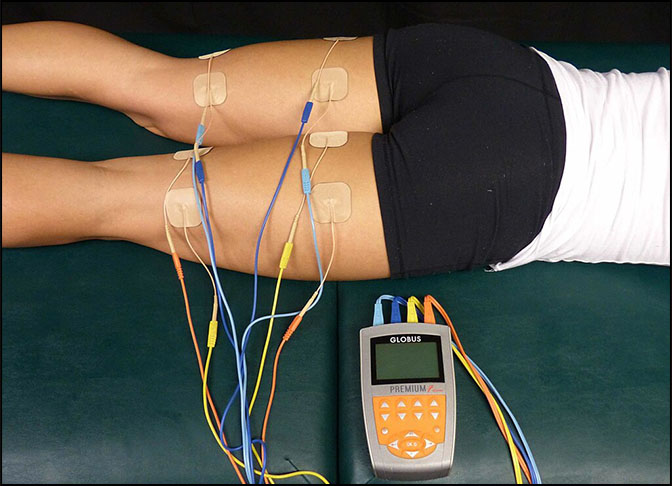
Electrical Muscle Stimulation (EMS) is the use of electrical impulses to stimulate involuntary muscle movement. The impulses are applied using an EMS Unit, electrode pads, and wires – though wireless options are available.
HEALTH BENEFITS
I initially took an interest in EMS because of its ability to help with Poor Circulation.
HOW I USE EMS
As a woman with Multiple Sclerosis (MS), I obtained a number of secondary medical issues, one of those being Poor Circulation in my legs. To combat my Poor Circulation, I turned to EMS.
When I discovered that inflammation can cause MS relapses, with relapses being the worsening of current or creation of new MS symptoms, I began researching inflammation triggers. That’s when I discovered that medical issues, like Poor Circulation, are inflammation triggers and that the EMS was not only helping me with my Poor Circulation, but also helping manage my inflammation.
And managing inflammation helps me manage my MS.
PREFERENCES
I prefer to use an iReliev TENS + EMS Pain Relief and Recovery System. It’s easy to carry and easy to use. It’s never failed me. They also have a wireless unit. I tried it, but it stopped working within days. Note: I don’t do paid endorsements.
HAS EMS HELPED ME?
Yes. EMS has very effectively helped me maintain blood flow in my legs. And overtime, I realized that the EMS was also helping me in other ways.
Another medical issue I acquired, due to my MS, is Paraplegia – which for me is the partial paralysis of the lower half of my body. I discovered that the EMS was helping maintain and rebuid muscle in my legs and glutes – muscle that would have naturally atrophied due to my Paraplegia.
I also discovered that the increased blood flow was helping with wound healing and that the maintained muscle in my lower body was in turn helping maintain bone density in my lower body.
And I believe that all of the above have also helped me manage my MS, by helping heal soft tissue damage or preventing muscle atrophy and osteoporosis, which would have triggered inflammation.
CAUTION
I always do my own research and read reviews when investigating medical equipment and/or therapeutic gadgets.
I hope the information I’ve shared here is helpful.
-Jen, aka. Power Chair Dorothy
REFERENCES
Adams V. (2018). Electromyostimulation to fight atrophy and to build muscle: facts and numbers. Journal of cachexia, sarcopenia and muscle, 9(4), 631–634.
Hiroya Urabe, Ryuji Akimoto, Shohei Kamiya, Katsu Hosoki, Hideyuki Ichikawa, Toshio Nishiyama, Effects of pulsed electrical stimulation on α-smooth muscle actin and type I collagen expression in human dermal fibroblasts. Bioscience, Biotechnology, and Biochemistry, Volume 88, Issue 5, May 2024, Pages 522–528.
Ishikawa, M., Miura, H., Tamura, Y., & Murakami, A. (2022). Effect of Electrical Muscle Stimulation on Vascular Endothelial Function during Prolonged Sitting. Physical therapy research, 25(3), 127–133.
Jin, H. K., Hwang, T. Y., & Cho, S. H. (2017). Effect of Electrical Stimulation on Blood Flow Velocity and Vessel Size. Open medicine (Warsaw, Poland), 12, 5–11.
Katoh K. (2023). Effects of Electrical Stimulation of the Cell: Wound Healing, Cell Proliferation, Apoptosis, and Signal Transduction. Medical sciences (Basel, Switzerland), 11(1), 11.
Luo, R., Dai, J., Zhang, J., & Li, Z. (2021). Accelerated Skin Wound Healing by Electrical Stimulation. Advanced healthcare materials, 10(16), e2100557.
Riviati, N., Darma, S., Reagan, M., Iman, M. B., Syafira, F., & Indra, B. (2025). Relationship between Muscle Mass and Muscle Strength with Bone Density in Older Adults: A Systematic Review. Annals of geriatric medicine and research, 29(1), 1–14.
Sui, H., Dou, J., Shi, B., & Cheng, X. (2024). The reciprocity of skeletal muscle and bone: an evolving view from mechanical coupling, secretory crosstalk to stem cell exchange. Frontiers in physiology, 15, 1349253.
Science Direct: Electrical Muscle Stimulation
Not in Kansas Anymore (www.notinksanymore.com) is a site/blog authored and managed by Jen, aka. Power Chair Dorothy (pwrchr-dorothy). This site/blog is intended to provide educational and research information, and to share the author’s experiences.
The author of this site/blog is not a medical physician and this site/blog does not provide medical advice. This site/blog contains information that should not be used in place of a visit, call, consultation or the advice of your physician or other qualified healthcare provider. If you choose to apply or implement any information posted at this site/blog, you do so at your own risk.

