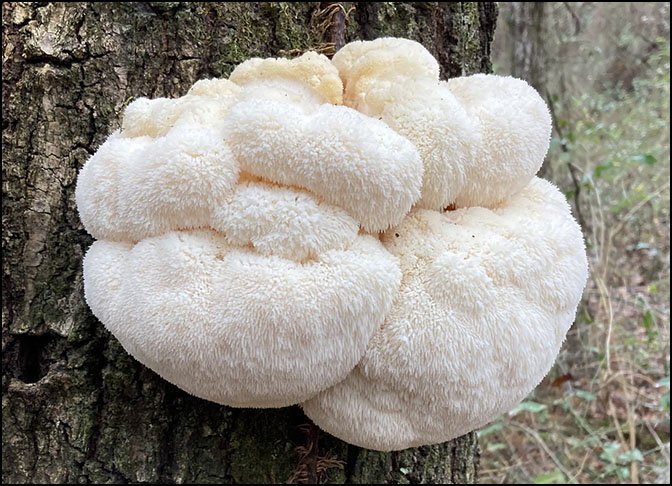
Lion’s Mane Mushrooms are also known as Hericium erinaceus.
HEALTH BENEFITS
I took an interest in Lion’s Mane Mushrooms because of their neuroprotective and neuroregenerative properties. These properties come from bioactive compounds contained in the mushrooms, specifically the compounds Hericenones and Erinacines.
HOW I USE LION’S MANE MUSHROOMS
As a woman with Multiple Sclerosis (MS),I added Lion’s Mane Mushrooms to my natural remedies to help promote the healing of nerve damage I have incurred due to my MS, and to help prevent new nerve damage.
PREFERENCES
For the sake of ease, I ingest capsules containing a powdered form of the mushrooms, rather than cook and eat the actual mushrooms.
HAVE LION’S MANE MUSHROOMS HELPED ME?
Yes. I believe that Lion’s Mane Mushrooms have helped repair some of the nerve damage affecting my left hand, improving dexterity and muscle control.
Lion’s Mane Mushrooms are also purported to have anti-inflammatory, antioxidant, and antimicrobial properties. But I have not witnessed or identified any other benefits, related to these properties, or not.
I look forward to seeing what the future brings.
CAUTION
I experimented with Lion’s Mane Mushroom powder, on and off for over 10 years, before finding one that appears to actually work or me in 2025. Many of the powders were ineffective and some spiked my blood sugar, because they contained high carb fillers. This experience reinforced for me the importance of double checking sources and reviewing ingredient lists before trying a new item.
Allergic reactions can happen to anyone, so I do my research and keep my eyes open to any potentially dangerous reactions, especially drug interactions, when I try anything new.
Ingesting large amounts of anything can be harmful, so I always consume in moderation.
-Jen, aka. Power Chair Dorothy
REFERENCES
Ma, B. J., Shen, J. W., Yu, H. Y., Ruan, Y., Wu, T. T., & Zhao, X. (2010). Hericenones and erinacines: stimulators of nerve growth factor (NGF) biosynthesis in Hericium erinaceus. Mycology, 1(2), 92–98.
Contato, A. G., & Conte-Junior, C. A. (2025). Lion’s Mane Mushroom (Hericium erinaceus): A Neuroprotective Fungus with Antioxidant, Anti-Inflammatory, and Antimicrobial Potential—A Narrative Review. Nutrients, 17(8), 1307.
Huang, H. T., Ho, C. H., Sung, H. Y., Lee, L. Y., Chen, W. P., Chen, Y. W., Chen, C. C., Yang, C. S., & Tzeng, S. F. (2021). Hericium erinaceus mycelium and its small bioactive compounds promote oligodendrocyte maturation with an increase in myelin basic protein. Scientific reports, 11(1), 6551.
Qiu, Y., Lin, G., Liu, W., Zhang, F., Linhardt, R. J., Wang, X., & Zhang, A. (2024). Bioactive substances in Hericium erinaceus and their biological properties: a review. Food Science and Human Wellness, 13(4), 1825-1844.
Szućko-Kociuba, I., Trzeciak-Ryczek, A., Kupnicka, P., & Chlubek, D. (2023). Neurotrophic and Neuroprotective Effects of Hericium erinaceus. International journal of molecular sciences, 24(21), 15960.
Wang, J., Wu, J., Yamaguchi, R., Nagai, K., Liu, C., Choi, J., Hirai, H., Xie, X., Kobayashi, S., & Kawagishi, H. (2025). Uncovering Hericenones from the Fruiting Bodies of Hericium erinaceus through Interdisciplinary Collaboration. Journal of Natural Products, 88(1), 80–85.
Science Direct:: Hericium erinaceus
Not in Kansas Anymore (www.notinksanymore.com) is a site/blog authored and managed by Jen, aka. Power Chair Dorothy (pwrchr-dorothy). This site/blog is intended to provide educational and research information, and to share the author’s experiences.
The author of this site/blog is not a medical physician and this site/blog does not provide medical advice. This site/blog contains information that should not be used in place of a visit, call, consultation or the advice of your physician or other qualified healthcare provider. If you chose to apply or implement any information posted at this site/blog, you do so at your own risk.
 Not in Kansas Anymore